Do not forget to checkout my post on Sainj Valley Himachal Pradesh. Also, check out my 10-day Himachal itinerary. Do check out my post on Mcleodganj itinerary,
Adventure
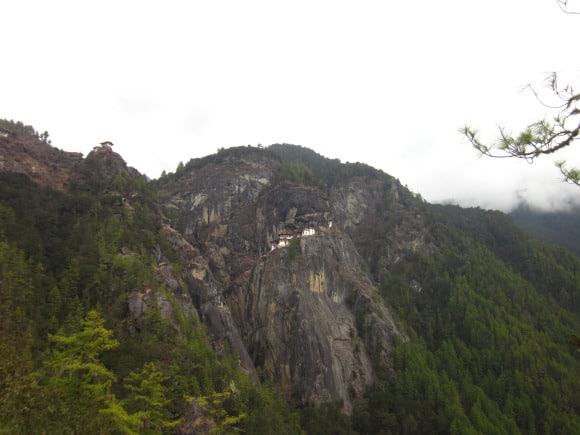
Tiger’s nest is like a secret monastery, which stayed in oblivion, waiting to be discovered. The photo below shows the Paro Monastery from the beginning of trek. Can you spot the Tiger’s Nest here?
Spot the nest!
Tiger’s nest is a name given to “Paro Taktsang” monastery. The story behind the name is fascinating. “Paro Taktsang Monastery” was built by Gyalse Tenzin Rabgye in 1692. Rabgye was believed to be the reincarnation of Guru Rinpoche (Padmasambhava).
According to a legend, Guru Rinpoche flew to this monastery in Paro, by riding a tigress. He meditated for 3 months here and conquered evil spirits. Imagine a tigress flying with a divine Guru riding it!The story gives you chills!
The first glimpse of the Paro monastery is magical! When you spot the Tiger’s nest for the first time, you consider reaching it next to impossible. The trek might be strenuous for 1st timers. However, it is not very difficult.
First glimpse of the Paro Monastery
You can choose to ride instead of trekking
We left Paro city early in the morning. We started the trek around 9 AM to reach before 1 PM. If you plan to explore the interiors of this magical monastery, you have to reach there before 1 PM. The lunch break between 1 PM to 2 PM may keep you waiting. Also, while returning, you may find the descend difficult as the sun is about to set.
After we started the trek, we found ourselves passing through woods and rocks. It was as like being an explorer in search of treasure. We discovered many shortcuts on the way. This made the trek more exciting. However, some shortcuts were way more difficult than imagined and we had to retreat back to the original trek.
I consider Europe to be an enchanting land of experiences and attractions. Across the continent, you can find a wide variety of interesting indulgence. Be it cultural, adventurous, gastronomic or leisurely. Europe has something for everyone.
I am an adventure enthusiast. A year ago, I spent 15 days in the southern region of Spain, near Seville, to become a certified skydiver. Unfortunately, due to lack of time, I was not able to get my certification.
But I did get an unprecedented taste of adventure, when the tandem instructor is not really piggybacking on you, but just holding you. After the parachute opens, you are on your own and the task of landing safely is upon you! I did land on my own, 8 times! My experience of learning Skydiving in Spain was the biggest adventure I ever had.
Unfortunately, due to the dedicated time spent in Spain, I was not able to indulge in other adventure activities. So, I reached out to the travel blogging fraternity and asked their favorite adventure activity in Europe.
Thank you for all the entries! This definitely is my bucket list when Europe opens up completely.
Hoping this covid19 pandemic ends soon and I am able to tick these bucket list adventures soon!
Read through the list and share your bucket list adventures in comment section!
Dog Sledding in Rovanemi, Finland
by Jordan Adkins (inspiredbymaps.com)

One of my favorite adventure activities in Europe has always been husky riding in Rovaniemi in Finnish Lapland.
Huskies are certainly cute and cuddly, but they are also fierce runners. That is what they are breed for – and they love it. On my day trip with Bear Hill Husky, I got to get up close with these dogs and get an idea of how they are prepared and conditioned to be as fit as they are. Once I was familiar with their set-up, and the dogs, I was able to take an exhilarating trip through the noble taiga forests of Lapland in a cart attached to these muscles up pooches.
Wind-racing, heart pounding, the embracing chill of the wilderness, and the sound of silence – I loved it all. And I dare say the huskies were even more enthusiastic than I was! The tour is only offered below 10 degrees Celsius for animal welfare reasons but can be done with or without snow. You can go for just a few hours, or sign up to multi-day trips for the ultimate Lapland adventure including north lights options, night mushing, camping, sauna, bonfires, and more.
Dog Sledding in Tromso, Norway
By Megan Starr (meganstarr.com)

One of the best adventure activities in Europe is dog sledding. While it can be a bit daunting to do your research and make sure you pick an ethical husky sledding company, if you do find the right one and participate in the activity, you will be rewarded with a once-in-a-lifetime experience in an unbelievable Arctic setting. If you’re looking for awesome places to participate in the activity, look no further than Tromsø, Norway… the country’s winter capital.
There are several activities and excursions in Tromso, but dog-sledding is one of the premier ones. When you go dog sledding in Tromso, you will want to bring the right clothing and mindset. It will be cold! The company you go sledding with will provide suits but it is always good to come prepared with snow boots, mittens, and whatever else helps keep you warm. During the journey, you can choose whether you want to be a musher or the one riding in the sled.
It will depend on your age and physical stamina. But, regardless of which one you pick, you are in for an epic journey! It is one of the best adventurous activities in Europe… and the world!
Snow Mobiling, Finland
By Nisha & Vasu (lemonicks.com)

The thrill of driving a snowmobile in a subzero temperature over vast expanse of snow white landscape is something different. I have done it several times in the best places to snowmobile in different countries and each one of them has been a fulfilling experience.
The first time, donning my gloves & helmet, I was a little apprehensive of handling it. I was taught by the instructor how to handle the vehicle and the do’s & don’ts. He also checked my clothes and shoes. Those who did not have proper gears were provided the same. The snow mobiles vehicles are heavy and have runners instead of wheels to slide across the surface & cut through the snow.
But this was not my first time. I was in the Lapland region of Finland. And quite comfortable with snowmobiling. As always, the instructor was in the front and we followed him in a line keeping distance between us. It was pure fun and an adrenaline rush.
The trees were laden with snow. I was totally mesmerized by the surrounding white beauty. It appeared to me as if I was in a different world. We crossed ups & downs of slopes, saw lovely little villages, and occasional snowmobiles en route. Beautiful wooden houses as well. The only noise I could hear was of the snowmobiles.
After around 2 and half hours our ride was over. I didn’t want it to be. To compensate, we then went to have hot chocolate followed by a sumptuous lunch in one of the finest restaurants.
Climbing Svolvaergeita in Lofoten, Norway
By Radka Stankova (realcamplife.com)

Svolværgeita is an iconic rock formation that towers 355 meters above Svolvær – the administrative capitol of the Norwegian archipelago Lofoten. Svolværgeita, which translates to Svolvær goat, got its name because of the two pinnacles on the top which shape resembles goat horns. There are several climbing routes, which makes Svolværgeita attractive for experienced climbers, as well as beginners, who can climb to the top via an easy two-pitch route with a climbing guide.
The view from the top is breathtaking and a little bit intimidating, to be honest. Especially if you plan to jump in between the goat´s horns. The jump is 1.5 meters across, and about a meter down, which doesn´t sound like a lot but trust me that when you are standing on the edge of the rock and watching the small landing platform on the other side, your heart will skip a beat.
You do not have to be afraid though, the guide on the other horn is there to give you a steady hand once you land. We climbed Svolværgeita independently, but if you do not have experience with climbing we would recommend Northern Alpine Guides.
Climbing Via Ferrata, Scotland
By Kathi Kamleitner (Watchmesee.com)

The Scottish Highlands are full of adventures, but did you know there was only one place to climb a Via Ferrata in Scotland?
A Via Ferrata is a climbing route where climbers are continuously secured to a steel cable. Iron steps and ladders make it easier to scale the rockface without much climbing experience.
The Via Ferrata in Kinlochleven (near the famous Glen Coe) runs up alongside one of Scotland’s tallest waterfalls, the Grey Mare’s Tail. From the top, climbers enjoy fantastic views of the surrounding mountains and lochs. This activity is only available as a guided experience.
Check Vertical Descents for upcoming tours.My personal highlight on this climb was to cross the gulley high above the waterfall on a set of steel cables – and zip lining above the roaring river. While physically challenging, I love that a Via Ferrata makes climbing much more accessible. It’s great fun and a unique experience in the Scottish Highlands.
Mountain biking in Madeira, Portugal
by Mansoureh Farahani (travelwithmansoureh.com)

Madeira Island in the middle of the Atlantic Ocean and just a few hours flights away from mainland Europe is a heaven for mountain biking. I tried mountain biking for the first time in Wales and I fell in love with this fun activity. That is why, when I was in Madeira I took a 4-hour mountain bike tour to explore the mountains on the island. Usually, the tour companies provide you with a bike and helmet. If you want to have a comfortable ride, bring your cycling gloves and a waterproof jacket.
We rode through amazing paths, where we were amazed how fast the weather can change in this tiny island. When we began our tour it was sunny but later we experienced heavy fog and rain and when we finished the tour at the bottom of the hill, the sun was out again.
There are various fantastic trails for any levels. If you are a beginner, you can have a relaxed bike ride through some stunning paths and admire the gorgeous scenery, but if you are more experienced you can go on the challenging trails.
Paragliding – Austrian Alps
By Ben Reeves (thesabbaticalguide.com)

Having travelled extensively in Europe, my favourite adventure activity was definitely paragliding over the Austrian Alps. Austria is a country more often visited in winter, but in summer the blue skies accent the incredible Alpine ranges and make the views when paragliding incredible.
We stayed in the small Tyrol town of Ellmau and booked to paraglide with a local company Skydance Tandem Paragliding. I will admit to feeling very nervous as we took the lift (more commonly used for skiing) up to the top of a mountain.
After a safety briefing and being strapped into the tandem harness we were instructed to ignore our instincts and run full throttle downhill towards the edge of a cliff. The chute quickly took hold and before reaching the edge we were whipped up into the sky. It was an incredible experience, giving literally a birds-eye view of this stunning part of Northern Austria. Once the initial adrenaline passed it was a relaxing and peaceful experience, one I would highly recommend.
Parasailing over the Atlantic, Portugal
By Diana (travelsinpoland.com)

Parasailing is an incredible experience, all the more so when you are able to do it over the ocean. Off the coast of the algarve, the summer months are filled with tourists and visitors from all over the world. Dozens of companies are spread out over many beaches providing a variety of activities from kaaking to parasailing. The parasailing company in Albufeira had no specific regulations as to the age of its participants, but allowed people with a certain height and weight to experience. In other words, if children reach their height limit, they are able to go with an adult over the ocean.
The adventure itself was an amazing experience. First, the company took 4 people out on a motorboat right off the coast. Then they would set up the ropes and the parachute and have you sit while they tied all the necessary ropes around you. Once the boat took off you would slowly be pulled out into the ocean and finally into the air. It was extremely peaceful, slow moving and calm. Once you are in the air, everything moves slower. The experience in the air lasted about 10 minutes but felt like much longer. The company also took pictures that you were able to purchase afterward. It was one of the best outdoor adventures to experience.
White Water Rafting, Trentino, Italy
By Teresa Gomez (broganabroad.com)

The Brenta Dolomites in Trentino, Italy are a playground for adventure lovers. From hiking to wild swimming and climbing, there is something for everyone. But for me, after spending a few days cycling, kayaking and exploring dramatic canyons, the highlight was white water rafting in River Noce in Val di Non.
River Noce has been listed by National Geographic as one of the world’s top 10 places for river sports, and it’s the only European river on that list. So prime location for water sports!I wasn’t too sure about trying white water rafting myself. This was my first time and I’m scared of water. And it didn’t really help that a few days before there had been a rainstorm and water levels were considerably higher than usual.
Despite this, I went ahead with it and I ended up absolutely loving it! Not only did I have fun doing it, but I wished I had more time there so I could do it again. I would definitely recommend white water if you are visiting Trentino in the summer, even if you are a novice like me.
White Water Rafting in Slovenia
By Becki Rendell (meetmeindepartures.com)

If you’re into adventure sport, then Slovenia is an Adrenalin junkies dream. The region surrounding the Julian Alps and the towns of Bled, Bohinj and Bovec are all amazing places to get your climbing, zip-lining, mountain biking and canyoning fix. However, one of THE BEST adventure sports to do here is white water rafting.
There are two main rivers for rafting in Slovenia: the Sava (which is great for first-timers and young families, because it’s got lower grade rapids) or for the more adventurous, the River Soča, which boasts Grade III-IV rapids. I’ve done quite a bit of white water rafting before, so naturally, my choice was the Soča River.
The river is a beautiful turquoise blue colour, with the backdrop of the Julian Alps and the forests, this is one of the most scenic places I have rafted. Because the water for both the Sava and Soča are fed by the melting snow, even in summer the water is a chilly 14 degrees (you do get a wetsuit and water boots). You can raft in Slovenia from April through to October. I opted for a 3-hour rafting trip as part of the Emerald River Tour through a company called Mamut. I 100% recommend.
Scuba Diving between tectonic plates, Iceland
By Lora Pope (Explorewithlora.com)

Iceland is full of adventurous activities but one of the most unique is snorkeling/diving at the Silfa Fissure in Thingvellir National Park.
Silfra is a rift between the North American and Eurasion tectonic plates that you can do diving/snorkeling in. What makes this experience so unique is that while diving you can actually touch both plates at the same time. If you aren’t certified to dive, you can also snorkel on top and witness the rift from above. The water in Silfra is fresh spring water, with a visibility of over 100m! I’ve never seen water this clear while diving before! It’s also safe and delicious to drink.
The water is very cold so you will be given drysuits, headgear, and gloves to keep warm. The best time to visit Iceland for this activity is during the summer when the country gets the warmest weather. Silfra makes a great day trip from Reykjavik, as it only takes about an hour to get there from the city.
Scuba Diving in Gozo, Malta
By Suzanne (meanderingwild.com)

Gozo is a small island off the north coast of Malta and has some of the best scuba diving in the Mediterranean. I had never dived here before and was really surprised by how beautiful the landscape was below the surface. Gozo is a very rocky island and this continues underwater but the fish that swarm around you as you swim through the caves and the corals and sponges that live on the rocks made it a magical experience.
I was also lucky enough to dive the wrecks that are on the south coast of Gozo, one which is called the Karwela. These were scuttled (sunk on purpose) to provide dive sites and the Karwela is perfectly placed. As you swim across the blue water from the shore she appears as a shadow at first before becoming clearer.
Swimming through her decks was a perfect memory of this beautiful island. I dived with Bubbles Dive Centre who are based in Marsalforn and take all levels of divers. They are really safety conscious but great fun to dive with at the same time, the perfect combination.
Surfing in Ireland
by Emer & Nils (letsgoireland.com)

If you want a refreshing outdoor experience, head to the west coast of Ireland, where an entire section of the Wild Atlantic Way coastal drive is devoted to the Surf Coast. From Donegal Town to Erris in County Mayo, there are many amazing surfing locations including long sandy beaches, such as Streedagh Strand.
The constant swells from the Atlantic Ocean also mean that, unlike some other surfing locations, waves are never in short supply. Bundoran is undoubtedly the surf capital of Ireland and a favorite location for beginners of all ages. The Bundoran Surf Co. is a great choice that will help get you started. Professional surfers will be impressed by the waves of Mullaghmore Head and the best waveriders in the world are blown away by the monstrous Aileen’s Wave just off the Cliffs of Moher!
Surfing in Ireland is an incredibly invigorating experience, not least because the max water temperature doesn’t ever reach above 20 °C. The great conditions and chilled surfing atmosphere on the west coast of Ireland will make you want to come back year after year. Don’t forget to check out the annual surf music festival (Sea Sessions) held in Bundoran.
Surfing in Portugal
by Alya & Campbell (stingynomads.com)

Portugal is an amazing country for outdoor lovers. The range of adventure activities is quite impressive from hiking and cycling to water sport activities such as surfing, kite-surfing, and diving. The southern part of the Atlantic Coast of Portugal is a world-renown place for surfing. The coast boasts one of the top big wave surfing spots in the world, the famous
Narazé. Sometimes the waves here get as big as a 10-story building.
This place is a great spot for professional big waves surfers. For beginners like myself, places along the Costa Vicentina just south of Lisbon are much more suitable. There are several charming towns along the coast where you can find surf schools and gear rental places. The water along the Atlantic Coast of Portugal is quite cold even in summer. You’ll need a wetsuit for surfing here.
Praia de Odeceixe and Praia da Arrifana are my favorite places for surfing. Both places have sandy beaches which makes it easy to get into water and paddle out. Waves don’t get big here even if you’re not a good surfer you have a chance to catch a small wave or surf white water. There are other outdoor things to do on the coast like hiking, diving, kayaking, etc. The Coast Vicentina in Portugal is a great place for an adventure holiday in Europe.
Zip lining in the Cetina, Croatia
By Greta Omoboni (gretastravels.com)

If you’re a bit of an adrenaline junkie looking for thrilling adventures, then zip-lining in the Cetina Canyon in Croatia is for you. The Cetina Canyon is located close to the town of Omis, and can be easily visited on a day trip from Split.
We did the zip-line experience with Zipline Croatia. The meeting point is in Omis and they then drive you to the starting point at the top of the canyon. You will do 8 wires and gradually make your way down the canyon.
The longest wire is 700m and is 150m above ground level. Soaring through the air at high speed on this wire was a bit terrifying, but the views you see are simply stunning. The other wires are a mixture of long scenic ones over the Cetina River and shorter ones amongst the trees.
It was my first time zip-lining and I was a bit terrified, but once you start the fear washes away. You will be accompanied by two professional guides who will run you through a security demonstration before starting, and who are always present to help.It’s a thrilling experience and a must on any Europe adventure bucket list.
Ziplining in Wales
By Oliver Diprose (notbritsabroad.com)

Zip World is an adventure company with three sites in North Wales offering plenty of exciting activities. Their most unique and exhilarating experience is the Velocity 2 zip line at Penrhyn Quarry. Velocity 2 is the fastest zip line in the world and the longest in Europe.
I had the pleasure of riding this zip line on a beautiful misty July morning and it’s fair to say that it’s quite different from many other zip lines. For Velocity 2, you’re strapped down flat so you travel face first while holding onto your leg grips behind you. This only adds to the adrenaline rush!
The zip line is a little over 1,500m long and sits 500m above the blue lake of Penrhyn Quarry so the views during the ride are pretty spectacular. When the ride starts, it feels slow for a moment but that soon picks up considerably with it reaching speeds of over 100mph. Less than 60 seconds later and you’ll come to a quick but painless stop back at the bottom of the quarry.
If you can, try and be first in the group on Velocity 2 because there’s a viewing area underneath the zip line once you get off so you can watch everyone else fly down above you.
Kayaking at Archipelago in Finland
By Alexander Popkov (engineerontour.com)

Finland is a land of thousands of lakes and islands. I think the ultimate way to experience it is to go kayaking during a bright summer night. Sunset and moonlight create beautiful, colorful reflections in the calm Finnish waters. In June – July, you can see the sunset, moon, and sunrise within only a few hours.
My favorite Archipelago is at Espoo. It is only half an hour from central Helsinki. There are plenty of kayaking rental options, including overnight. A very good way to experience the Espoo archipelago is to camp on one of the islands. Here, you have to make sure you stop at an island that is open to the public, not on a privately owned.
The list of these islands can be found here on the city’s website. Alternatively, you can take a scheduled archipelago boat. It stops at each of these islands two times a day.
Kayaking the Dordogne river, France
By Jennifer & Tim (luxeadventuretraveler.com)

France’s Dordogne is the valley dotted by a thousand castles. One of the best ways to take in the beautiful of the medieval villages seemingly cut into the cliffs and crowned with their castles is from the water on a Dordogne kayaking trip down the river.
As France locals living in the region, Jennifer and Tim of Luxe Adventure Traveler recommend the 16 kilometer route from Vitrac to Beynac as one of the most scenic. You paddle past three of France’s officially designated most beautiful villages and five picturesque castles. The water is often calm enough to create a mirror effect and the Dordogne is a sanctuary for bird life.
There’s even a number of spots you can paddle ashore to take in attractions from visiting the castles themselves to learning about the local trades like walnut oil production. If a day on the river isn’t enough, you can also kayak on multi-day trips and camp along the way. Though there’s no shortage of companies dotting the river banks and offering kayak and canoe rentals, Jennifer and Tim recommend the family-owned Canoës Loisirs. They speak English and have been a respected family business operating for many years.
Kayaking in Emerald river, Slovenia
By Nisha Dalal (nerdyfootsteps.com)

Kayaking is one of the most popular adventure activities in Slovenia. And the best place to enjoy kayaking in Slovenia is the Triglav national park. We had the opportunity to explore this wonderful park that is full of waterfalls, alpine peaks, mirror lakes, emerald rivers and so much more. To plan your trip, I highly recommend this detailed article about the Triglav national park in Slovenia.
The best part of the park is the opportunity to kayak in the wonderful Soča river, also known as the emerald river due to its beautiful and unique color.
Different sections of the river in Soča Valley are appropriate for different levels of kayaking expertise. From beginners to experienced Kayakers, there is something for everyone. Everything with the backdrop of the stunning scenery.
A special permit is required for navigation on the River Soča. Before you head to the river, check out information on the navigation regime and security. The best way to enjoying kayaking in Slovenia is with a professional company that handles all these details for you and provides you the safety gear, kayaks, and required training. I will highly recommend 3glav adventures who are one of the best teams in Slovenia to organize this
Canyoning in Croatia
By Jennifer Aspinwall (worldonawhim.com)

Canyoning is one of the most exhilarating adventures available to you in Croatia. If you have never heard of canyoning before, not to worry. I hadn’t either until I spent time in Interlaken, Switzerland, a place dubbed by many as an extreme sports capital of the world. However, I went to Interlaken in December which is not an ideal time to traverse a canyon by hiking, abseiling, climbing, and swimming through a body of water, even in a wetsuit.
Six years later, I finally got the opportunity to go extreme canyoning down the Cetina river with Adventure Dalmatia tours. The river is less than an hour away from Split, which should absolutely be a stop on your Croatia itinerary not only because it has a beautiful port, but it is where the famed Diocletian’s Palace is located. Since the canyoning site is an hour away from a major city, we drove to the Adventure Dalmatia tour office in our rental car and the company took care of the rest.
We climbed down a gorge, swam and jumped our way through a river and abseiled down a rock face. Extreme was the best way of putting it as it takes a lot of energy, strength, and stamina to make your way successfully through the Cetina!
Canyoning in Madeira, Portugal
By Roshni Patel (Thewanderlustwithin.com)

Located 300 miles off the coast of Africa, this volcanic Portuguese island of Madeira offers some of the best landscapes for outdoor activities. One of the most breathtaking things to do in Madeira is to go canyoning.
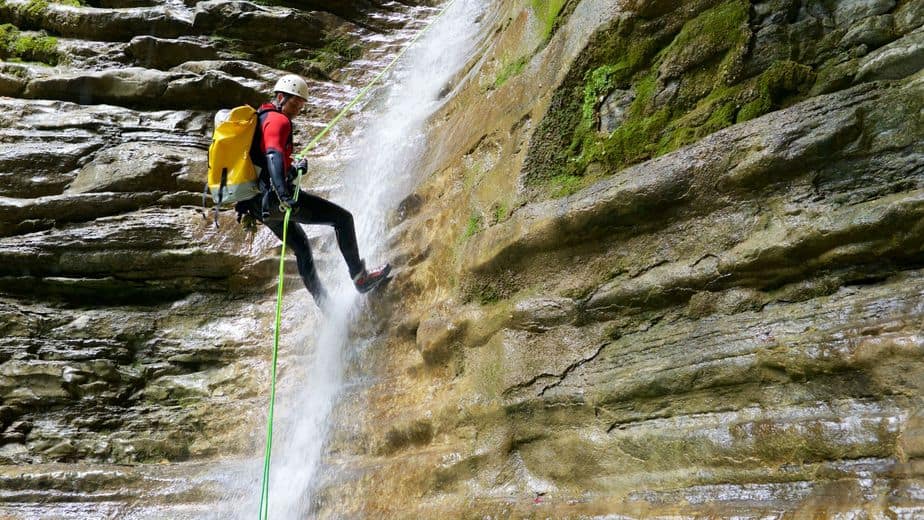
This exhilarating sport takes place in Ribeiro Frio, a canyon that consists of eight rappels along the way. The canyon is located within the UNESCO site of the Laurissilva Forest, that is one of the seven wonders of Portugal. I did the beginner level course which lasted three hours and included two rappels, the highest of which was 18 meters, and required swimming, and jumping through waterfalls, as well as hiking through the lush landscapes of the canyon taking in the beautiful scenery.
Our tour company, Madeira Adventure Kingdom, provided shoes, a wet suit, helmet and harness so all we needed was a swimsuit, towel and a change of clothes to enjoy this adrenaline fueled activity.
Alpine coaster in the Black Forest, Germany
By Hannah Golton (hannahshappyadventures.com)

During the year I spent living in Freiburg just outside of the Black Forest in Germany, there were many amazing adventure activities I completed. However, one stuck with me – the Hasenhorn alpine coaster in Todtnau.
After arriving at the location, you’ll take a chairlift to the top of the mountain. Once you reach the top, be prepared for a big adrenaline rush. Seat yourself on a comfy chair complete with seatbelt and buckle in for the ride. The coaster takes you down the mountainside, with multiple twists and turns. You control your speed with the brake system on your own cart. Most of the time the coaster is quiet, meaning you don’t have to worry about people behind or in front of you. It costs just €10 for the trip up and down the mountain. The views are also incredible from the top.
Due its stunning location in the Black Forest, there are multiple other activities to keep you entertained from hiking to skiing to cable cars. Todtnau is also famous for its waterfalls, so don’t forget to see them on your trip there.
Northern Lights wilderness tour, Finland
By Cazzy Magennis (dreambigtravelfarblog.com)

Our Northern Lights wilderness tour that we took in Finland easily ranks as one of my all time favourite adventure activities! Like most people, seeing the Northern Lights has always been one of my lifetime goals, and during our time in Finnish Lapland, there seemed no better chance to try and see them than here.
We decided to go on a wilderness tour, not just so that we had a better chance of seeing them that night, but so that we could learn more about them. We still had weeks left driving through Finland and Norway so the knowledge we could gain here would be put to good use. And in reality, our guide from Wild About Lapland was absolutely amazing!
He was so knowledgeable on all aspects of hunting for and capturing the Northern Lights and it helped set us up for future success on our trip. Though we didn’t get to see them that night, we still had a wonderful time exploring and trekking through some of Finland’s most beautiful lakes and forests. We also had the chance to sit by a roaring fire, learning more about Finnish culture and enjoying fire-roasted sausages with local sinappi mustard.
Boat trip to Benagil Cave, Portugal
By Darek Pawlak (darekandgosia.com)

If you are looking for unique adventure activities in Europe, you have to visit Algarve. Located in the southern coast of Portugal, it is one of the most visited regions in this part of Europe, famous for its wide, sandy beaches and rocky cliffs.
Thanks to the stunning coastline, there are many amazing outdoor activities to do. One of them is visiting Benagil Cave.
This beautiful cave is only accessible from the sea. If you don’t fancy to swim you can book one of the boat tours. Trips take place from nearby cities such as Carvoeiro and Lagos and included not only Benagil Cave but also a few others nearby.
When choosing the tour, check the size of the boat. Large ships do not enter the cave, so pay attention to the exact description placed on each trip.
The south of Portugal really is amazing, and you will be able to experience the beauty of various rock formations from a sea level.
Camp Adventure in Denmark
By Derek Hartman (Everythingcopenhagen.com)

One of the most unique destinations for adventure in Europe is Camp Adventure in Denmark. The grounds are located an hour south of Copenhagen, making it an easy day trip for those visiting the Danish capital.
We visited Camp Adventure earlier this year and were enchanted by the main attraction – a 45-meter-tall forest tower. To reach the tower, we hiked about 1 km through the tranquil forest of southern Denmark.
The hike is over a slip-proof wooden boardwalk which makes the hike possible for children and visitors with mobility issues. Along the hike we checked out the intricate ropes courses and giant tree swing that are also available at Camp Adventure.
Once we reached the base of the tree tower we gazed straight up at the hourglass shape and rings of upward sloping boardwalk ramps. You can easily walk to the top in 15 minutes, but the idea of a tree top forest tower is to enjoy the climb and take in the unique views of nature around you.
Once we reached the top, we enjoyed the stunning views of the forest below. The tree tops gave us a view that few are lucky enough to enjoy and we took it in for a while before snapping some photos and circling the top platform for the full panoramic.
Jet Boating on Lake Brienz, Switzerland
By Carolyn June (holidaystoswitzerland.com)
A fun way to get the heart racing is aboard a jet boat on Lake Brienz, right next to Interlaken in Switzerland. It’s just one of the many things to do in Interlaken for adrenaline junkies.
After a short shuttle ride from Interlaken to Bonigen, passengers are kitted out in life vests and given a safety briefing. Then it’s all aboard the high-powered jet boat for the ride of your life!
Lake Brienz may look tranquil but once you’re onboard the boat, you are soon racing across the turquoise water so fast you are too busy holding on tight to admire the view!During the jet boat ride, the driver performs 360° turns and high speed drifts before putting his foot down to accelerate quickly again.
He also takes you past the impressive Giessbach Falls and shares some history of the region.After the ride, you are transferred back to Interlaken and will be able to download some amazing action photos from the ride.Jet Boat Interlaken rides are suitable for both adults and children and are available from mid-April to mid-September.
Hiking Hadrian’s wall, England
By Monique Skidmore (tripanthropologist.com)

Hadrian’s Wall was the northern limit of Brittania and of Roman rule for three hundred years. Constructed in 122Ad on the orders of Emperor Hadrian, the Wall included forts, towers, and whole towns for garrisons of Roman soldiers and stretched right across the country from Bowness-on-Solway to Wallsend on the East coast of Northern England.
Hiking Hadrian’s Wall National Trail is becoming a top adventure activity in England. Walking the entire distance is a trek of five days, but it’s possible to stay along the way at pubs, inns and even castles, or just take a day trip from Newcastle or Edinburgh.
A new Hadrian’s Wall cycle way has been built that travels alongside the wall for large sections and free camping, while not legal, is certainly popular along the Wall!
My favorite time to hike Hadrian’s Wall is in the early spring when it is also lambing season in Northumberland. You can watch them jumping over each other and over the stone walls as you travel along the Wall in this wild and beautiful northern countryside.
Howth Cliff Walk, Ireland
By Krystianna Pietrzak (volumesandvoyages.com)

My favorite adventure activity from traveling is hiking the Howth Cliff Walk in Ireland. Howth is a tiny coastal fishing town just north of Dublin, and it’s easily reachable within 30 minutes by public bus.
Normally, you’d have to pay for an adventurous activity, but this cliff walk is completely free! All you need are good sneakers and clear skies, because I wouldn’t suggest doing this hike in the rain.
There is absolutely nothing between you and the water, which can be kind of scary! There’s a few different routes depending on how hard you want your hike to be, but I did a mixture of a few of the routes and just followed the great view of the water. I did the hike in slightly under two hours, but if you choose a different route, it could take longer or shorter!
I also packed lunch for my hike. There’s a great spot for a picnic about halfway through that you won’t want to miss because it offers sweeping views of the cliffs and the water!
Hike to Mt Etna in Sicily, Italy
By Annabel Kirk (smudgedpostcard.com)

We absolutely loved our family tour of Mt Etna, one of the most active volcanoes in the world. Located on the Italian island of Sicily, Mt Etna is usually smouldering and frequently erupts.
We arranged a private tour with EtnaFinder who tailored the trip around our young children. Our guide Marco, was excellent at explaining the history and geography of the volcano in a way that our kids could understand. Our children relished their bumpy ride in the 4X4 which crossed inhabitable terrains.
We clambered on old lava flows (and slid down them), saw a house which had been consumed by lava and the kids enjoyed sitting on top of a lava “bomb” and exploring a lava cave. We were able to visit lots of different parts of the volcano which visitors wouldn’t be able to access independently.
The only time we came across another person was at the Rifugio Citelli where we enjoyed a hearty lunch.
The trip is easy to do from the popular town of Taormina on the east coast of Sicily, or from Catania where international flights arrive
Hiking in Jotunheimen, Norway
By Linn Haglund (brainybackpackers.com)

Jotunheimen National Park is an amazing playground for any outdoors enthusiast and home to some of the best hikes in Norway. I have done several hikes in the national park, many of which I can’t even remember the name of. However, the most memorable of all was Besseggen ridge hike from Memurubu to Gjendesheim.
It is a stunningly beautiful hike, like all others in the park, but with my vertigo, it was especially challenging to climb up the narrowest part of the ridge. With 700 meters straight down on one side and 300 meters straight down on the other, it’s pretty much free climbing up the vertical boulders you’re balancing.
While Norwegians in general are known for embracing the outdoors (including myself), you’ll see people of all ages doing this hike. From young children to their grandparents.
But that didn’t make me any less shaky once I got to the top and it shouldn’t make you underestimate how challenging this hike is either. Most people do it on their own, though it is possible to go on guided hikes too.
Hiking at Kjerag, Norway
By Pericles Rosa da Nova (7continents1passport.com)

When I went to Norway I couldn’t miss the opportunity to do one of the most famous adventure activities in Europe, the Kjeragbolten hike. After spending one and half day in Olso, I took a flight to Stavanger, then a bus to Øygardstøl, the starting point of the Kerajbolten hike. But the hike was not easy! Full of ups and downs, sometimes I walked on stepping-stones, other times in streams, through waterfalls, and even mud.
There are some chains attached to the ground and a T (trail) painted in red on many rocks across the trail. Actually there are so many rocks on this hike, that sometimes I wondered if I were walking on the moon. After hiking for 1:50, I arrived at the Kjerag boulder and I just smiled like an innocent child in this awe-inspiring moment. The suspended rock that I saw several times on social media was right there in front of me.
The daredevil rock stands at around 1000m (3281ft) high, but standing on top of it didn’t scare me. The view of the fjord was unbelievably beautiful!! The magnificent scenery included three waterfalls, the snow-covered landscape and the fjord’s lake.
I felt so happy and blessed for seeing the Norwegian fjords for the first time.
Hiking in Sierra Nevada, Spain
By Joanna Davis (theworldinmypocket.co.uk)

Sierra Nevada are the highest mountains in continental Spain, and the second highest in Western Europe after the Alps. The Mulhacén peak reaches a hight of 3,478 meters and makes a great summer challenge to hike. Most of the people who attempt hiking Mulhacén are doing it over two days, spending the night at the official refuge or in their own tents, in the Caldera from the west.
Sierra Nevada Mountains are a fantastic eco system which offers hikes for every type of visitor, be it advanced or not. There are easy hikes along the Béznar reservoir in the Lecrín Valley, suitable for the entire family. For the more adventurous ones, Ruta de los Cahorros in Monachil offers a fantastic experience of canyon exploring, crossing hanging bridges and bathing in the pools formed at the bottom of a waterfall.
When you go hiking in the Sierra Nevada mountains, there are many opportunities to meet wildlife, such as the Iberian ibex, who likes to show up on the rocky trails. A specie native to the national park is the Sierra Nevada blue butterfly, easy to spot at lower altitudes.
Being so close to Granada, Sierra Nevada make a wonderful day trip in nature from the hustle and bustle of the city.
Walking the Camino de Santiago
By Dave Chant (davechant.com)

I’m staring up at the Santiago cathedral, tired and sore. My sandal has broken and my foot is threatening to come out with every step. I can see red on my socks and know that my toes have been bleeding through the material. I’ve finished the Camino Frances and it’s been the best thirty days of my life.
The Camino de Santiago is actually a network of routes. There are many ways to walk to Santiago from Portugal, Spain and France. Yet the most popular is the Camino Frances, from the sleepy town of St Jean Pied de Port in France over the Pyrenees and through the stunning towns of Pamplona, Burgos and Leon en route.
Of course, it’s not just about the big towns. The joy is in the people you meet, the shared pilgrim dinners (three courses and wine for 10 euros – yes please!), the scenery, and the time to contemplate. Whether you’re religious, spiritual or just like a good walk, it’s the slowing down that really opens the mind and calms the body and soul. All you need to do each day is get up, decide how long you want to walk, and stop. It cuts life down to its simplest elements.
Accommodation is mostly in albergues, dormitory style rooms like hostels, where board can be found for under €10 a night. Some are still run by donation only (donativo). If you want to live a little more in luxury, there are private rooms and B&Bs in some of the villages, but you start to detract from the experience.
The route is around 780km and will take you around a month to complete but take six weeks off just in case. It will probably be the best thing you’ve ever done.
Hardergrat Hike, Switzerland
By Jackson Groves (journeyera.com)

The Hardergrat ridge is known as one of the hardest day-hikes in Switzerland with its ominous drop-offs and enduring distance. With more than 2000m of incline to be climbed throughout the 20km+ ridge, it’s a trail only to be attempted by experienced hikers.
From the ridge-line hikers have incredible views of Lake Brienz and in the background, the Swiss Alps are constantly looming. It’s no wonder the Hardergrat hike is constantly listed as one of the most beautiful day-hikes in all of Europe.
The trail is situated above the popular town of Interlaken in central Switzerland, which is the adventure capital of the country. The trail begins at Brienzergrat, which is a train station above the town of Brienz. Then, it covers 20km from Brienzergrat all the way through to Harder Kulm Station.
A train services both the Brienzergrat and Harder Kulm stations so you can do the hike in either direction. From Brienzergrat to Harder Kulm, it takes most hikers more than 6-hours and there is no water, food, toilets or infrastructure available along the way, which makes this hike even harder.
The Hardergrat ridge-hike is recommended for experienced hikers only, especially on wet days when the steep cliffs and big drop-offs can be unforgiving and perilous. It’s also recommended for hikers to use trekking-poles and to carry enough water for the entire hike.
The optimal way to do the hike is to catch the train up to Brienz, hike along the ridge to Harder Kulm station and then take the train down to Interlaken. However, if you want a huge challenge, you can hike up to Brienzergrat from Brienz and then down to Interlaken from Harder Kulm, which makes it an even tougher hike with 3000m+ of inclin
Hiking in Tatras
By Sean lau (livingoutlau.com)

Anyone looking for adrenaline-pumping activities in Europe must not miss the incredible amount of mountain ranges the continent has to offer. Whether it is the Alps, Carpathian Mountains, or any other stunning geological peaks, visitors can unquestionably find hikes and treks that will amaze them. For me, I found my fair share of adventure in Europe hiking the Tatra Mountains (sometimes referred to as Tatras).
Located along the edge of Poland and Slovakia, this mountain range forms a natural border between these two Eastern European countries. Travelers can decide which side of the mountain they want to use as their base for hiking, either side provides hikes and treks of various difficulties.
Since I was traveling in Poland, Zakopane is the place to go. Situated on the extreme Southern end of Poland, Zakopane is naturally at the foot of the incredible Tatra Mountains. Experienced hikers can access the most difficult trek in the entire Tatras, Orla Perć, directly from the town of Zakopane.
However, hikers must be well-prepared as this 6 to 8-hour hike has claimed over 100 lives. Other visitors looking for a less extreme hike can visit the Morskie Oko Lake. A short hike that takes over 2 hours, it is the perfect introduction to the vast wonders that the Tatra Mountains have to offer.
I hope you liked these contributions! They are certainly worth including in your Europe bucket list, aren’t they?
Which adventure activities from this list that made to your bucket list? Let me know in the comment section below.
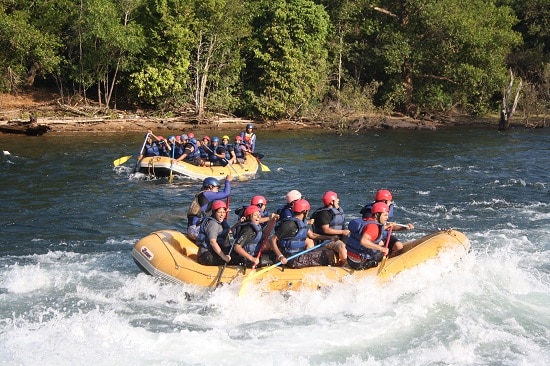
Dandeli is a rafting destination in South India. Located at a distance of 465 KMs from Bangalore, this destination is a favorite spot for adventure seekers. Most of the rapids in Kali river are of grade 2-3. But, there are a couple of grade 4 rapids as well. The rafting stretch is of 9 KMs. Dandeli river rafting can be a fun activity in Karnataka.
I tried Dandeli river rafting when I was in Goa. One fine Saturday morning, I left with my friends for Dandeli river rafting as the sun scattered the overnight fog away! We had already booked our Dandeli river rafting session.
Enroute Dandeli River rafting
It took us 2-3 hours to cover the distance of approximately 140 KMs from Panjim. We checked in a lodge with basic amenities. The travel agent with whom we had booked the rafting, gave us our time slot. We were waiting for the next morning to arrive, so that we can challenge the current of river Kali in Dandeli and enjoy the much anticipated Dandeli river rafting expedition.
On the same day, It was around late evening. We got the news that our rafting session might be cancelled. The travel agent was apparently arrogant about this. We held him responsible for spoiling our fun. But, we missed the real reason behind our rafting slot being cancelled.
The real reason was the Supa dam. Before river Kali passes through Dandeli, it crosses Supa Dam. The flow of the river thereafter depends on the Supa Dam gates and so does river rafting in Dandeli. If the flow of the Kali river is not massive, Dandeli river rafting is not allowed. If rafting is performed in meager flow, the chance of raft hitting the rocks increases. In our case, the travel agent was not sure if the Supa dam gates will open during our slot. However, we understood his helplessness and spent some time playing mafia & savoring Maggi. We finally slept, waiting for the next morning to bring some good news. We hoped our Dandeli river rafting session to get scheduled again.
Waiting for the next Morning in Dandeli
The next morning, to our pleasant surprise, the Supa Dam gates were open and there was adequate river flow for a successful rafting session. We were excited and apologized to the travel agent for our seemingly rude behavior. We had reacted with anger when we heard cancellation of our Dandeli river rafting session. All psyched, we embarked upon the journey that would take us to the spot from where rafting would start.
We were assigned a leader who would guide us through the rumbling Dandeli river. We followed him and took charge of raft to venture into the mighty river. Before the rapids started, our leader forced us to jump in the calm parts of the river. This was to drain out a single ounce of fear before we plummet into the rapids. Luckily, our life-jackets didn’t ditch us and we were finally equipped with the courage to enter the rapid zone!
“Left, Left, Right, Right” were the words our leader kept on repeating. He had taught us how to steer our raft along or against the current. When the rapids would approach, we were supposed to take control of ourselves by sticking our feet in the raft. This was to avoid being toppled.
The first rapid approached. It was a grade 2 rapid. But, it looked like the waterfall they show in Indiana Jones movie! Some of us were trembling with the fear of being toppled off the raft and hitting a rock. It was our first rafting experience after all!
Approaching the first rapid during our Dandeli river rafting expedition
Left! Left! Left! Our leader wanted us to get the raft straight before we plunge in the rapid! He yelled! We steered! But, the raft was not completely straight and it swept along with the river force, tilted. But, to everybody’s relief, we had crossed it with success. It took us a minute to realize that. The realization was followed by happy and loud cheers, shooting through the silence of Dandeli forest. We had not stopped rejoicing from our first success and the 2nd rapid had already approached! The Dandeli river rafting expedition was turning out to be great fun!
For the 2nd we were equipped with confidence and courage along with excitement. We successfully conquered the 2nd rapid as well. However, not everybody was on the raft this time!
Our leader had been toppled! He was nowhere to be seen. We were all scared. The next rapid was going to be a grade 4! Without the leader, how were we supposed to navigate through the most difficult rapid during our Dandeli river rafting expedition?
Finally, we spotted him on a rock. He had drifted towards the shore and had caught hold of a rock. Another raft leader helped him on board our raft again. Once he was on board, we were ready to face the mightiest rapid of our Dandeli river rafting expedition!
We gathered courage and headed towards the fiercest rapid! With loud cheers, we were approaching the roaring fall. Finally, we were to experience the highlight of our Dandeli trip!
There was a loud roar and we were submerged in the waters. For a moment, it felt like my heart stopped beating. We kept plunging downwards measuring the depth of Kali river. But, we erupted back, with loud cheers! We had crossed the fiercest rapid in Dandeli! However, One of my friends had toppled over the raft. Luckily, he was not injured and climbed back, yelling in excitement.
After the most fiercest rapid of Dandeli river rafting expedition
The rapids finally subsided and we were in the calmer river belt now. But to keep things exciting, we raced along with other rafters. The rafting session ended with a gentle of river stream passing through sky scraping trees and pin-drop silence. I spotted a white snake slithering beneath our raft and it made me smile. The beauty of nature made me smile.
After the session ended, we relaxed in the calm river near the shore. It was blissful. All our fears and inhibitions from water evaporated into the serene environment.
Relaxing in waters after successfully completing Dandeli River Rafting expedition
We were both exhilarated and relaxed while returning back to our lodge. We lazed around and captured the moments on celluloid. It was time for us to frame Dandeli in our memories. We left Dandeli, reminiscing a wonderful experience.
Exhilarated & Relaxed. Just before leaving Dandeli
Planning to visit Dandeli? Book from the official website: Dandeli.com. You can contact them at 94839-40400 or drop an email at book@dandeli.com.
Have you been to Dandeli? Share your experience in comments.
The Flock of sheep enroute Triund (Triund Trek)
This flock helped us to complete the moderate stretch. We were exhausted and decided to relax at a tea shop. This was not an ordinary tea shop. It was magical! The view from here was spectacular. As we sat sipping tea, overlooking the mountain, the best feeling sank in. The feeling of rejuvenation! The feeling of tranquility! It was phenomenal. We were so excited about reaching the camping site after this view!
Amazing tea with a view, Triund (Triund Trek)
The Magical view from Tea shop (Triund Trek)
We were exuberant to reach the trek. But, our body was against it! Once we spent some time at the tea shop, it was difficult for us to trek forward. The most difficult stretch of reaching Triund was starting now! We were now taking frequent breaks. Eventually, the trekking time was less that resting. As we struggled to reach the peak, we saw some european folks happily hopping on rocks and galloping towards the Triund camping site. But, our pace had slowed down a lot.
On the way to Triund, my exhausted friend, Akshat (Triund Trek)
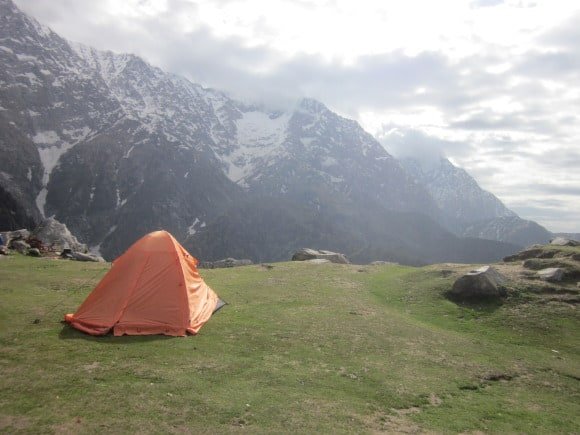
We mustered all the energy possible. Finally, we reached the camping site. The 5-6 hours of strenuous trek was totally worth it! The view of the majestic, snow clad mountains was pristine! We found some fellow travelers. They were either setting up tent or spending jolly time. It was around 6.30 pm when we reached. We missed the gold-plated view of the mountains. But, what we were seeing, was still amazing. There was a small shop which had some stock of food. We enquired if he can cook for us. To our pleasant surprise, he narrated the available food items. We chose Alu Paratha with mixed vegetables and tea. As he prepared our dinner, we started setting up the camp. Meanwhile, the bonfire was also prepared. We sat around the bonfire with some foreigners and talked about their experiences from India. These travelers were from Israel, Italy, France, Russia and many other countries! I couldn’t help but appreciate their urge to travel the world!
The first view from Triund Camping site (Triund Trek)
Setting up camp, Triund (Triund Trek)
Campfire at Triund (Triund Trek)
The dinner was ready and a russian solo traveler joined us to relish some lip-smacking indian food. We talked about her travel experiences. While chatting, she noticed that I was shivering from cold. She offered me her jacket as she was not feeling anything! We were shocked! It was 2 degree for crying out loud! But, she was from Siberia. That’s no match. After having dinner, we again spent some time with foreigners. Finally, it was time to sleep. We slept like a log!
The next morning was pristine! We requested the shop owner to provide us breakfast and he readily agreed. It was the simplest breakfast. But, we enjoyed every bit of it. We soaked in the morning view for some time.
The Shop at Triund (Triund Trek)
Breakfast at Triund (Triund Trek)

The last pic at Triund (Trek to Triund)
After breakfast, we packed up our tent and started our descend. The next task was to get a foot massage and sleep for 2 days, straight!
Mullayanagiri is the highest peak in Karnataka, situated in the lush green district of Chikmagalur. As you approach Chikmagalur district, you can start seeing the Nilgiri range of mountains. Mullayanagiri stands tall amidst all the mountains as a jewel.
During our stay in Chikmagalur, we stayed at Nesting Grounds Homestay. The homestay owner was kind enough to help us by arranging a cab for Sight seeing. A trip to Chikmagalur is considered to be incomplete if you don’t visit Mullayanagiri peak. Hence, we made an itinerary which would help us in visiting this highest point in Karnataka.
On the 2nd day of our trip, we went sightseeing. We first visited a waterfall and then proceeded for Mullayanagiri. Being the highest peak in Karnataka, we expected a long trek awaiting us. Hence, we had planned to save enough daylight for us. We reached the Mullayanagiri base by around 3 pm. After that, it was an 8 km pleasant drive through the whistling woods, overlooking the Chikmagalur town. As we traversed through the mountain curves, the sight of Chikmagalur town increased in grandeur. We were getting more and more excited to reach Mullayanagiri peak.
We had booked a cab and were fully prepared to be told by the driver to get off the car start the trek. But, to our pleasant surprise, the car kept on discovering roads which led to the top. At one point of time, we saw a lot of cars parked and started rolling up our sleeves to start the trek. But, we realized that we were still 3 KMs away from Mullayanagiri peak. The parking lot that we saw was Seethalayanagiri. A useful tip here. Most of the drivers halt here at Seethalayanagiri. They would say that the road ahead is dreadful. He may be right, but with careful precision, he can drive 3 more kms to reach Mullayanagiri peak. However, If you feel like trekking an extra 2 KMs to reach Mullayanagiri peak, you can ask your driver to wait at Seethalayanagiri and enjoy your trek further.
Our driver was quite a sport and he continued to drive further up. The road from Seethalayanagiri to Mullayanagiri should not be attempted unless and until you are a ‘pro’. However, if you have a bike, you can conveniently ride it to the top of the peak.
We reached where all the roads ended and saw a parking spot, overlooking a valley. We now had to climb some 500 steps to reach the topmost viewpoint from the peak.
The view kept getting better and better as we climbed the steps. Finally, we reached the top and the view was now truly breathtaking. The vast landscapes spread to infinity in front of us. All that we did was to take a deep breath and admire nature’s elegance. There was a small temple at the top. We visited the temple and post that started our descent.
The trek to Mullayanagiri is not at all arduous. But, if you are looking for a strenuous trek, you can trek from Mullayanagiri to Bababudangiri peak. However, the view from Mullayanagiri is slightly better than Bababudangiri .
Mullayanagiri makes a perfect picnic spot due to the magnificent view. I would surely recommend this attraction if you are planning a weekend in Chikmagalur.
If you are planning to visit Chikmagalur soon, you can have a look at my recommendations for places to visit in Chikmagalur
It was the last Day of Rupin Pass trek. We were at around 14,000 feet, wrapped in multiple layers & admiring nature’s magnificence. The clear sky resembled a canvas, waiting to be painted. The white clouds swiftly tagged along with the wind. The endless terrain of snow spread till the horizon. The sun had just appeared above a peak, keeping us warm enough in this cold weather. We were taking a break after 3 hours of the steep climb on snow from our yesterday’s campsite. Our eyes were glued to our trek’s steepest climb in front of us. That steepest trail would help us cross Rupin Pass!
With excited cheers and a clap, we started the toughest ascent in our trek. The guides motivated us continuously. After 20 minutes, we had only reached halfway. I looked up. The climb looked endless. Below, a seemingly treacherous valley stared right back at us, waiting for one of us to lose balance. We slipped, shuddered, grabbed our trekking poles firmly and took each step with caution while listening to our guide. Eventually, after 45 minutes, we had crossed Rupin pass! We had achieved the highest altitude of our trek, 15350 feet!
View from Rupin Pass en route Rupin pass trek
It was a moment of exhilaration! The spectacular terrain of endless snow made all our fatigue disappear! We had achieved what we dreamed of every single night after we were picked from Dehradun by the organizers. As I gazed at the stunning landscape in front of me, I couldn’t help but reminisce about the past 7 days of Rupin pass Trek.
The Rupin pass trek started from Dhaula base camp. I had opted to experience the trek with Indiahikes. On Day 1, I reached the base camp from Dehradun. It’s an 8-10 hour drive. When I reached Dhaula base camp, I knew that Rupin pass trek would be one of my best travel experiences. Nature was so pure here! The majestic Rupin river flowed calmly over the rocks. The clear sky looked pristine with the playful clouds tagging along with the playful wind. The lush green forest trees stood mighty tall, letting sun rays gently pass through. The mountains covered most of the blue sky and the birds chirped, forming heartwarming melodies. Our tents fluttered gently in the mild wind.
I settled my backpack in a tent and wandered in the jungle. I stared, just stared, at these peaceful surroundings. After a long time, I was not carrying my Phone. I had thrown it in the tent along with my backpack. Oh, what a great feeling it was to not be tied down!
Staring at the pristine Rupin river, Rupin Pass Day 1
My Tent at Base Camp, Dhaula (Rupin Pass trek)
After having early dinner, I retired to my tent, crafting imaginary stories about the next day.
On Day 2 & 3, we walked through dense forests amidst nature, gaining moderate altitude. The untouched beauty of Nature was breath-taking! The green envelope surrounded us as the elegant Rupin river played hide and seek with us. Our Day 2 camp was a small and cozy wooden house in the peaceful village of Sewa. The locals were very friendly and I enjoyed some games of volleyball with them. Jiskun, where we stayed on Day 3, was an equally charming village where I made some friends! These friends were cute little kids who loved getting clicked!
Trekking through dense forest – Rupin Pass Trek, Day 2
Playing Volleyball with locals of Sewa Village on Day 2 of Rupin Pass Trek. In the background, is our stay
Making friends at Jiskun, Rupin Pass – Day 3
Day 4 was when Rupin Pass trek started surprising us! We crossed through a dense and damp forest, climbed snow bridges and saw the calm Rupin river turn into a ferocious river. After a considerably tough terrain and many snow bridges, we finally reached one of the prettiest campsites you can imagine. The Udaknal camp was like a masterpiece painting come to life. The orange tents fluttered in the gentle winds, the lush green trees swayed with elegance, the calm horses grazed through grass and the snow clad mountains stood tall with spectacular grace. But, this was just a slight glimpse of what was in store for us the next day!
Udakanal Camp, Rupin Pass Day 4
Rupin pass trek evolves from good to stunning on Day 5. The green pastures gradually disappear and the snow terrains cover most of the path now. We steadily crossed snow bridges which were now looking endless! We gradually approached towards the most beautiful campsite in India, Dhanderas Thatch or Lower Waterfall Camp! Knowing this fact made our pace rapid and we completed trail before estimated time! We didn’t regret the extra pain, inflicted upon us due to rapid walk when we stared at the view! The Panoramic view of lower & upper waterfall was the most beautiful landscape I have seen in my life! If anybody decides to bring Alice to India, this would be her wonderland!
Lower Waterfall Camp, Rupin Pass Trek – Day 5
View of Lower & Upper Waterfall from the camp, Rupin Pass – Day 5
The majestic snow clad mountains and dark clouds covered every bit of the blue sky. The dark clouds showed their prowess and I experienced the first hailstorm of my life! The tents swayed wildly and bits of snow were scattered in our campsite. Spending an evening, surrounded by nature’s beauty in its purest form possible, was a splendid experience. The whole experience of being so close to nature was that of a lifetime!
The next morning, on Day 6, we started our trek towards the Upper Waterfall Camp. We climbed along the lower & upper waterfall which ferociously splashed on the rocks below, creating a sweet melody. We climbed carefully on the snow as a minor mistake can throw us in these ice cold waterfalls, disappearing under the thick blanket of snow.
Lower Waterfal – Rupin Pass Trek – Day 6
Upper Waterfall – Rupin Pass Trek – Day 6
With the help of micro-spikes, we got a good grip on the snow while trekking. We gained altitude with each step now. The air was thinner, leading to much more physical stress than before. We were advised not to make much noise as that might cause an avalanche! At one point, some snow melted in one of the surrounding mountains and a big thunder echoed in the mighty Himalayas. Luckily, nothing catastrophic happened. We decided to take rest and capture nature’s beauty on celluloid.
Enroute Upper Waterfall Camp, Rupin Pass Trek – Day 6
View while trekking to Upper Waterfall Camp from Lower Waterfall Camp. Can you spot the lower waterfall camp? – Rupin Pass Trek, Day 6.
Staring at the stunning beauty of mighty Himalayas
Finally, we reached the Upper waterfall camp, the 2nd last camp of Rupin pass trek.
The Upper waterfall camp was nestled amidst mighty snow clad mountains, next to where the glaciers melted to form Rupin river. The landscape surrounding this camp resembled a vanilla ice-cream, topped with choco-chips. The snow resembled vanilla and some rocks played the role of choco-chips! The vibrant tents and our clothes were the only colors in this giant vanilla scoop!
Upper Waterfall Campsite, Rupin Pass Trek – Day 6
In the evening, we decided to climb a nearby mountain and slide our way back to the camp. The experience of sliding rapidly was terrifying as well as exciting. I rolled in all possible directions while coming down! But, this prepared me mentally for longer slides the next day where we would lose 400 feet of altitude in few minutes!
See the tents down there? I was supposed to slide down till there! Rupin Pass Trek (Day 6)
Later that evening, the sun was shining brilliantly and I ventured out to catch a glimpse of spectacular snow landscapes, shining due to the bright evening sun.
The evening view from a peaceful spot near Upper Waterfall Camp
“How tiny we are in front of Nature” (Photo Credits: Shubham Pathak)
I returned back to the tent once the sun had set behind one of those humongous mountains. After an early dinner, we retired to our tents, preparing for the longest and toughest day ahead. The next day, we were going to walk 16 KMs!
Next day arrived quickly because we got up at 3 AM in the morning and allowed our bodies to get habituated to the cold. Post breakfast, we started the toughest day of Rupin pass trek, with mighty hope in our heart. After walking for 3 hours, we took some rest before embarking upon the steep ascent for Rupin pass.
Ready to climb Rupin Pass (Day 7)
Climbing Rupin Pass. Can you guess where is Rupin Pass in this image? (Day 7)
While climbing, we also saw foot-steps of a snow leopard! As we trekked towards Rupin Pass, we knew that a snow leopard was carefully observing us, ready to pounce if an easy target is spotted. Lucky for us, snow leopards are shy animals! After continuous and cautious efforts, we had finally crossed the Rupin pass. It took us 45 minutes to climb the toughest ascent and reach the highest point in our trek, 15350 feet!
View from Rupin Pass
Admiring the pure & pristine nature from Rupin Pass
With my Trek mates at Rupin Pass (Day 7)
Innumerable snow terrains branched out of Rupin pass and turned into a spectacular landscape! We were followed by a herd of sheep along with 4 fierce-looking dogs. We rested for 30 minutes and congratulated each other for successfully completing the toughest ascent of our Rupin pass trek. We were overjoyed and nature’s beauty which we witnessed was beyond any beauty I might have seen in my entire life!
After admiring the pristine Himalayan beauty, we started our descent towards our last campsite at Ronti Gad. This campsite was yet another example of miraculous beauty Himalayas can offer.
Ronti Gad Camp, Rupin Pass Trek (Day 7)
View from one of the tents in Ronti Gad, Rupin Pass Trek (Day 7) (Photo Credit : Shubham Pathak)
The low layer of clouds covered our tents and as I sipped piping hot tea from a warm cup, I couldn’t help but repaint the view from Rupin pass in front of me. Oh, what a great decision it was to opt for Rupin pass trek, I wondered.
On Day 8, we started our descent towards Sangla, a beautiful little village in the scenic district of Kinnaur, Himachal Pradesh. The 12 KM descent was very arduous for shins and toes. The fact that Rupin Pass trek had ended made this last day even tougher.
Entering the beautiful Sangla Village – Rupin Pass Trek (Day 8) (Photo Credit: Shubham Pathak)
Finally, we were back to human civilization. We booked a cab for Chandigarh and I left the beautiful valleys of Himalayas with a heavy heart. As our 12-hour journey started, I began to replay the whole Rupin pass trek in my mind. The driver started playing old Hindi songs.
The air was filled with beautiful lyrics of a Kishore Kumar song:
“Musafir hoon yaaro
Na ghar hai na thikana
Mujhe chalte jaana hai
Bas chalte jaana…”
The dry twigs crumbled under our feet as we walked deeper in the forest. The evening sun was still bright, gradually inching towards the horizon. Behind us, the gentle breeze created ripples in backwaters of Satpura national park, where we alighted from our boat. We gradually moved far from our boat and closer to nature. The Langoors laid their eyes on us and birds chirped cheerfully. Many other eyes were rapt with attention, scanning us as we entered their ecosystem. Some eyes were curious, others afraid. But, in the multi-layered labyrinth of flora & fauna, we found ourselves ecstatic with joy, enthralled by the sheer & untouched beauty that Satpura National Park contained.

Our guide and Surya, our naturalist from Forsyth Lodge, kept their eyes attentive and senses sharp as we continued with our walking tour in the core forest area. Gradually, we were amidst the dense forest, far away from our boat. The ‘sound’ of forest captured our senses. In distance, subtle layers of forest & fading sun rays, bouncing off the green leaves, conjured up a magical world! I slowly transmuted in a phase of solitude, thinking about our normal lives. How far have we come from nature?! The concrete forests & sky high ambitions have engulfed our souls and made us crave for lamentable & selfish motives.
But then, not all the humans have forgotten the state of just ‘being’. In a forest, you are not rich or poor, fair or dark, famous or forgotten. But, you are nature, one with the curious Langoors or the arduous ants. Part of a Leopard’s territory or a Bear’s habitat. Your keen sight follows a bright yellow butterfly or spots a brilliantly beautiful spider! Your mind revels in nature’s myriad patterns. Be it a polished trunk of tree used by an antelope, trying to shed it’s antlers’ skin, or a dug up hole by a bear, to discover termites. You will be amazed how many secrets lay concealed in Forest. Satpura National park is one such forest reserve which will coerce you to transform in the state of ‘being’!

My train of thoughts was interrupted by a loud sound. A Langoor coughed loudly, warning a carnivore, either a leopard or tiger, that it was spotted. The guides and naturalists can swear by these ‘calls’ and guess presence of a carnivore in vicinity. So, when our guide signaled us, we abruptly halted and started scanning the forest.
These calls have a very interesting purpose. When a carnivore is planning for a hunt, it needs to be concealed behind nature. Camouflage is the biggest strength for carnivores. If it is spotted by a potential prey, the battle is half lost. Many times, the carnivore will retreat and not attack it’s prey after listening to the call, because the prey has now spotted it’s hunter and can easily escape. These calls also warn the other potential preys in proximity. Giving calls is part of the defense mechanism by herbivores and epitomizes co-existence in the ecology.
The Langoor’s call suddenly became intense. Other creatures joined in the symphony of calls and the atmosphere became electric! This was a clear indication that a carnivore was very, very close! We positioned ourselves on a perched rock, overlooking the valley below, laden with trees, in hope to catch a glimpse of the leopard or Tiger. We waited patiently, not moving a muscle as the Langoor’s call became more and more intense. But, eventually, the call stopped. The leopard had disappeared somewhere behind the dense forest. No kill had been made. But, we got a chance to experience an interesting phenomenon closely!
Our walk in the forest had now reached it’s completion. We started our way back to the backwaters, where our boat swayed along the wind.

I visited Satpura National park towards the end of 2015. I had an amazing experience there and the naturalists at Forsyth Lodge made sure that we enjoy wildlife. The biggest learning for me was that wildlife is not always about tigers or leopards. It is much more than that!
What makes Satpura National park unique?
Satpura national park is lesser known compared to the famous tiger reserves of Kanha or Bandhavgarh. There are no long queues of Jeeps, ardently seeking tigers. In fact, ours was the only Jeep at times when we took the morning Jeep Safari.
Satpura national park can be experienced in three ways. The 1st mode is a Jeep safari in which you can traverse through wilderness for 5 hours, unlike only 3 hours in major national parks. The 2nd way to experience wildlife is by walking in the core area of forest. Not only is it very exciting, but also a great way to experience wildlife up close. Satpura national park is one of the only two forest reserves in India, where you can walk in the core forest area. The other one is Periyar Tiger Reserve in Kerala. Canoe ride is the 3rd experience of witnessing the beauty of Satpura national park. The canoe ride is best done during early morning as you get to witness the magnificent sun transforming from gentle orange to bright yellow.
Jeep Safari trail which is not very crowded: In majority of national parks, you will find a lot of Jeeps, lined up to spot wildlife. But, in Satpura national par, there were very few Jeeps, scanning the forest. At times, our Jeep was the only one amidst pure nature!
The Jeep safari took us in the interiors of the core forest and I were enthralled by how peaceful this safari was! Devoid of tourists, Satpura national park displayed interesting landscapes. We spotted Langoors, Deer, Gaur and various birds, including an elegant Eagle and an Owl! We also searched for a leopard and followed multiple calls. But, we were not able to see any leopards.


Canoe ride: The canoe ride was amazingly beautiful and the morning sun was oh, so marvelous! The enchanting blanket of mist covered the lake’s surface which gradually disappeared with the Sun rising higher in sky. We spotted some rare birds and had a chance to get really close! Admiring these birds closely was an unforgettable experience! It felt like the birds of Satpura National Park had accepted us as their own.


During the Jeep and Canoe safari, Forsyth Lodge had arranged breakfast for us, amidst the beautiful forest. I was jubilant to not find a single piece of garbage at these spots. Having breakfast at these beautiful spots, with views to admire endlessly was a unique experience!


About Forsyth Lodge, where I stayed in Satpura National park
There are many resorts in Satpura national park and Forsyth lodge is one of the best properties here. I was invited by Forsyth Lodge to spend a weekend with some other blogger friends and I was utterly charmed by their hospitality and ambiance.
Located in a sprawling area, Forsyth Lodge has everything that you can expect from a wildlife stay and more! They have some brilliant naturalists, who are passionate about wildlife. During our stay, we participated in many experiences, apart from wildlife, like star gazing, butterfly walk etc. I was personally amazed by the knowledge bestowed upon us by the naturalists at Forsyth Lodge.

In absence of city lights, Forsyth Lodge has a unique charm at night. The dimly lit lamps soothes your senses and the cozy rooms will lift your spirits. They also have a wide repository of interesting books on wildlife. I was really impressed by their swimming pool which shimmered due to the afternoon sun as the trees around stood tall, dancing away in a carefree manner to the forest breeze!
Here are some property pictures!
How to reach Satpura National park?
This Tiger reserve is located at a distance of 180 KMs from Bhopal. But, a closer railway station to Satpura national park is Itarsi Junction, located at a distance of 90 KMs.
If you are traveling from Delhi, there are direct flights to Bhopal.
From Bangalore, there are no direct flights. So, you will have to take a halt at Mumbai to catch a connecting flight.
However, An overnight train from Mumbai to Bhopal is also an option. To reach Bhopal, it takes approximately 14 hours by train. But, I suggest you to end your train journey at Itarsi (12 hours), because after that, the train moves away from Satpura National park.
If you end the train journey at Itarsi and not Bhopal, you will reach Satpura national park 4 hours in advance. You will save the 2 hours that the train will take to reach Bhopal and also the two hours by road when you start from Bhopal to Satpura national park.
Useful Tips
1) Forsyth Lodge is a brilliant property! You can get all the details by visiting their website. They have passionate and knowledgeable naturalists who would change the way you look towards wildlife!
2) Best season to visit here is Summers for sighting and winters for a cozy and pleasant stay
3) There are elephant safaris here as well, provided the elephants are available. Do inquire.
4) There are different rates here for the Jeep safari duration. You can opt for a normal safari in which you can enter in Satpura national park at 6:30 am and stay till 11:00 am. You can also extend this safari till 12:30 pm by paying extra. There is also an option to book a full day safari in which you can stay as late as 5 pm. The costs for each safari varies and you have to decide which safari you would like to opt for before booking it. You cannot extend the safari once the permit is issued. For updated information, you can visit the official site.
5) As of now, you cannot book a safari online. You can either book it through your resort or yourself visit the ticket counter near the safari entrance and buy yourself a permit. Valid identity proof will be required to obtain permit.
6) To reach the Satpura national park, you will have the cross the backwaters by a boat. So, make sure you are not wearing slippery footwear which can result in you plunging in the cold water!
7) Please don’t do touristy things at Satpura National park. The beauty of this tiger reserve is still intact due to less tourists and hence, less touristy behavior. If you are visiting Satpura national park, please make sure that you act responsibly.
I hope you liked this blog post and found it informative. Kindly leave comments if you have experienced Satpura national park before. If not, start planning soon!
If you have any queries, feel free to comment and ask questions. You can also connect with me on Facebook, Twitter or Instagram
Road trips are absolute fun, aren’t they? A car, friends, food and one happy journey for miles. You can stop wherever & whenever you wish. You spot a road side vendor selling coconut water and just drive down the highway to spend some moments of joy with friends. Being spontaneous makes a road trip totally worth it!
In April, I enjoyed two road trips with friends. One was from Bangalore to Chikmagalur and the other destination was Wayanad. Early morning drive, with soulful songs playing as background score, is indeed a blissful experience. Both the times, I had my share of the wheel. In fact, when we went from Bangalore to Wayanad, I was the only driver. Clocking around 800 KMs in 3 days was tiring, yet enjoyable!

During these two recent road trips, I was looking for ways to make things more interesting and enjoyable! I am penning down my observations here which might come as handy travel tips for you while planning for a road trip. So, here are 5 essential travel tips for you.
1) Learn some games which can be played during the drive
Well, it can be a bit tough to spend 6-7 hours in a car, depending only on music. It would be great fun if you have some interesting games to play. My favorite game is cows and bulls. The game is easy to play and quite engaging. One person will think of a 4 letter word, others have to guess this word correctly. Let’s suppose I think of a word and my friends have to guess. If a position & letter matches, I will say bull. If only a letter matches, I’ll say cow.
Now, suppose I think of a word, let’s say ‘MUCK’. If someone’s guess is ‘KEPT’, I will say he got one cow. In this case, the letter ‘K’ is guessed correctly, but the position is different. So, other players know that my word has one our of the four letters of ‘KEPT’ and not at the same position.
But, if the guess is ‘SICK’, I will say two bulls. Now, other players know that two letters from ‘SICK’ are present in my word at exact position. Similarly, other players have to keep on guessing, analyzing the previous results and finally guess my word correctly. This can be an interesting game during a road trip.
2) Sleep well before the drive
Mostly, road trips start early in the day to avoid traffic. So, it’s essential for the driver to sleep well. People tend to ignore this simple point. Sure, you would be able to drive without proper sleep as well. But, it’s unsafe and can ruin your holiday. Imagine you are sleep deprived and you drive for 6 hours! Would you be able to enjoy your destination when you reach there? I guess not!
3) Be wary of state rules
If you are visiting another state, make sure you are aware of the rules. Don’t carry alcohol if you are crossing state borders. The border police can seize your alcohol and levy a hefty fine on you!
4) Don’t be too tight with schedule
If Google maps show 6 hours to reach your destination, don’t stick to it! Take breaks, stop spontaneously, enjoy the journey. Don’t try and rush your drive to reach destination. After all, a road trip is fun because the liberty it gives you, right? What’s the fun if you are road tripping for 6 hours with only one break of 20 minutes?
5) Respect nature & wildlife
This sounds very basic and simple. But, I witnessed people throwing plastic bottles while I was driving through Nagarhole National Park. Not only plastic bottles, one genius even aimed at a spotted deer with a beer bottle! How insensitive can people be! If you are not contributing in improving the ecosystem, at least don’t deteriorate it.
Well, I hope you found these travel tips for a road trip useful. Have you enjoyed a road trip before? What did you enjoy the most? Share your experiences with me in comments!
I tried hard, squinted my eyes, but couldn’t see the top of Chembra peak. Fluffy clouds were hiding the grandeur of Chembra peak. As the soft clouds glided swiftly along with a waft of wind, myriad patterns of nature unfolded in front of us. We had almost completed the trek. Another 30 minutes of trekking would help us discover a beautiful heart shaped lake enroute Chembra peak trek. We sat catching our breath back and glanced at the trek further. The climb, partially concealed by clouds, looked steep and daunting. But to marvel at the heart shaped lake, we rubbed off dirt and resumed the trek. Gradually, we reinstated our quest for nature and started trotting against the rough terrain and towards a phenomenal creation of nature! However, we would have to return from the lake as trekking upto the peak is not allowed anymore.
Chembra peak in Wayanad is one the most amazing treks one can opt for in South India. It doesn’t have the unpredictable terrain which is found in most of the rain forest treks in South India. Instead, Chembra peak is a perfect example of a trek which can provide rewarding views for anyone who is interested in nature, at a moderate effort.
Located at a distance of 13 KMs from Meppadi town, Chembra peak stands tall beyond the tea plantations and lush green landscapes. After you drive almost 10 KMs from Meppadi towards Chembra peak, you will reach a ticket counter. You have to buy tickets here in order to reach the heart shaped lake. The tickets include your guide fees, however, you wouldn’t require a guide to complete a trek as the path is marked clearly. But, paying these fees is mandatory.
Many people start their trek from the ticket counter itself. However, if you have your own car, you can drive further ahead. After the point, till where you can drive your car, trek to heart shaped lake measures around 3 KMs. If you don’t feel like driving on the tough terrain, there are jeeps plying on the route, from the ticket counter to the end parking spot.
Chembra peak starts amidst tea plantations and gradually takes you in the damp forest and surreal surroundings. The initial leg of trek is easy as you trot on dry twigs, with bountiful views of tea plantations and valley on your right. After a while, you will find yourself amidst stalwart trees and filtered sunlight. The Chembra peak trek starts becoming a bit steep gradually. We continued the trek cautiously, making the grip on ground stronger with every step.

Bountiful views at the beginning of the trek
A pit-stop before the actual trek starts

The trek begins to get a bit steep after this point (Chembra peak trek)
After we continued our trek for a while, we crossed the denser part of the forest and started ascending on a steeper part of the trek towards Chembra peak. The view behind us opened up and the valley which we saw earlier, looked even more gorgeous. With every step, we were inching closer towards the heart shape lake.
Further in the trek, we reached a point where clouds were almost at the same height as us. The clouds concealed the peaks around us but, Chembra peak stood tall, protruding above the clouds. However, the clouds gradually covered Chembra peak as well. We spent some time on this flat land before starting our last leg of Chembra peak trek.


The last leg of trek towards Chembra peak lake
The trek further looked very steep. However, it took us lesser effort as compared to the previous trek. After cautiously navigating our way pass boulders, we finally reached the heart shaped lake. The lake looked beautiful as the gentle wind created ripples in the water. There were government employees keeping a watch on us to make sure that we don’t touch the water or take a dip in it. Known as “hridhayathadakam” in the local language, the heart shaped lake is a beautiful sight to marvel at. We hiked around the lake and discovered a cliff, hanging over a valley, allowing a gorgeous view of beautiful landscapes stretched till the horizon. We spent some time there, marveling at the nature’s beauty. The Chembra peak stood tall behind us as we stared in awe at the valley below.
The gorgeous view from a view point near the heart shaped lake

The beautiful heart shaped lake! We were not allowed to trek further up and get a better view

After spending some time near the heart shaped lake, we started descending. There were chances of rain and we were supposed to trek down before the rains started. I was the last person to leave the spot as I tried to capture the best view of the heart shaped lake. But, the government officials were too strict to allow me trek a bit further. When I asked the reason why weren’t we allowed to trek till the top, I was given influence of Maoists as a reason. Well, it’s sad how politics can bar you from discovering nature! But, maybe this is just an excuse. The real reason may be saving an endangered bird species which is comparatively abundant near Chembra peak.
Finally, we returned back to the parking spot where our cars waited for us. On our way back, the sky was getting darker and the sun fainter. We were now heading back to our town, where a rainy evening waited for us!
You can read more about Wayanad on my blog. I have mentioned the other blog posts below.
Wayanad Itinerary
Places to visit in Wayanad
FAQs
I have answered some questions which I think can arise while planning for Chembra peak trek.
Can I trek till the top of Chembra peak?
Earlier, the trek used to be till Chembra peak. But, now you can only trek till the heart shaped lake. Due to the influence of Maoists, the government has banned the trek till the top of Chembra peak. However, this seems to be just an excuse. The actual reason is most likely saving an endangered bird species which is abundant only near the Chembra Peak.
How to reach Chembra peak?
If you have a car, you can drive till the parking spot from where the trek starts. If you are relying on public transport, there are buses plying from Kalpetta to Meppady. From Meppady, you can get an auto rickshaw which will charge around Rs 200 for one way. You will hire the whole auto rickshaw for Rs 200 and not per person
Is camping allowed?
You can not camp near the heart shaped lake. It was allowed 4 years back, but camping is now banned. This ban is unfortunate as I would consider it a beautiful camping site!
How long and tough is the Chembra peak trek?
If you start the trek from the ticket counter, the trek is around 4 KMs (one way). But, if you start from the parking spot beyond the ticket counter, it’s a 3 KM (one way) trek. Considering the steepness of the trek, if would take you around 3 hours to complete the whole trek.
The grade of Chembra peak trek is easy – moderate. I saw some kids completing the trek! However, the trek becomes difficult in monsoon as the rains tend to make the path slippery.
Is there a permission required for Chembra peak trek?
Yes, you need a permit from the forest departments. But, you can get the same from ticket counter itself. You don’t need to get a permit from anywhere else in advance.
How much does Chembra peak trek cost?
For a group of 10 people, the trek would cost Rs 750. For every additional member, Rs 75 more has to be paid. Carrying a camera would cost Rs 40. For foreigners, the cost would be double.
You might have read elsewhere that the trek costs Rs 500 for 10 people. However, this has been revised and the cost is Rs 750 for 10 people as of 15th April, 2016.
What are the timings for Chembra peak trek?
The forest department office, which issues permits and tickets, open at 7 am. You can start trekking once you have the tickets. The tickets are issued till 2 pm. However, you might have to leave the heart shaped lake by 3 pm, if there are chances of rain. The government officials would not allow you to stay there. So, it’s best recommended that you start the trekking latest by 10 am as rains are considered to be frequent in the evening time.
Is carrying plastic bottle allowed?
Yes, carrying plastic bottle is allowed. However, you will have to give Rs 20 per bottle as deposit, which is refundable once you complete the trek and show the bottle. This impressive step has been taken to keep the Chembra peak zone plastic free.
Is smoking/drinking allowed?
Smoking and drinking is strictly not allowed in the Chembra peak zone. In fact, there is a hefty fine, around Rs 5,000, if you are caught smoking or drinking
Is spotting wild life possible?
You might spot wild life. But, because there are many trekkers frequenting the place, the chances of spotting wild life is minimal.
Is there a guide required for Chembra peak trek?
Actually, there is no guide required for the Chembra peak trek. It is a clearly marked trek and you have other fellow trekkers along with you. However, a guide is compulsory and his cost is included in the ticket cost.
Is high level of fitness required for the trek?
The trek is pretty moderate and a basic level of fitness would suffice to complete the trek.
Which is the best season for the trek?
September – February might be the best season. March, April & May tend to be a bit hot. But, if you are lucky, you can discover the day to be cloudy. June, July & August are monsoon months which would make the trek slippery. However, the landscapes are lush green and amazingly beautiful.
I hope you liked the blog post and found it to be useful. If I have not covered your question, share it in the comment section.
Have you been to Chembra peak trek? Share your experience with me!